
Contents
If you find red flour beetles in your pantry, they can contaminate flour, cereal, and other dry foods with eggs, larvae, and waste. You’ll need to identify where they breed, inspect hidden cracks and stored packages, and apply targeted control measures before the infestation spreads. Effective management depends on sanitation, exclusion, and careful treatment, but some cases require professional intervention to prevent ongoing product loss.
Key Takeaways
- Red flour beetles infest flour, cereal, pasta, and other dry goods, causing contamination and product loss.
- Inspect shelves, seams, cracks, packaging, and storage voids for adults, larvae, frass, and damaged goods.
- Control infestations with sanitation, vacuuming, heat or freezing, and targeted treatments where needed.
- Use traps, monitoring, stock rotation, low humidity, and sealed storage to prevent reinfestation.
- Call professionals when beetles persist, larvae appear, or contamination requires confirmed eradication.
How Red Flour Beetles Damage Pantry Foods
Red flour beetles damage pantry foods by infesting dry, processed goods and feeding on broken grain, flour, cereal, pasta, and baking mixes, which leads to direct product loss and contamination.
You may see red flour damage when adults and larvae chew kernels, elevate moisture, and introduce fecal matter, cast skins, and secretions that degrade quality. This activity can reduce shelf stability and make stored foods unsuitable for use.
Because you’re protecting your household’s food supply, pantry prevention matters: seal packages tightly, store products in rigid containers, rotate stock, and clean shelves to remove residues that attract pests.
If you manage storage carefully, you’ll limit access, slow population growth, and reduce the chance that beetles spread through adjacent foods in your pantry.
Signs of a Red Flour Beetle Infestation
If you suspect a pantry beetle problem, look for live adults, slender reddish-brown larvae, and shed skins in flour, cereal, pasta, baking mixes, and other dry goods.
You may also notice fine frass, clumped particles, and a stale, musty odor from contaminated materials. These infestation symptoms often appear alongside irregular feeding damage and reduced product quality.
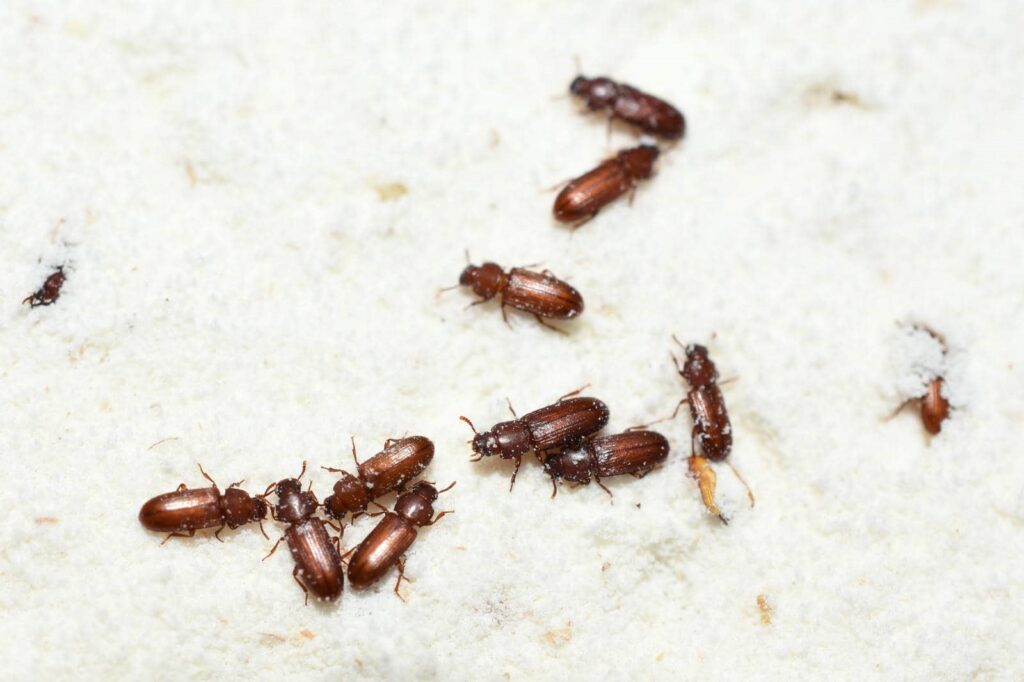
For accurate pest identification, inspect package seams, dispensers, and storage containers under bright light or with a hand lens. Adults are small, flattened, and uniformly brown; larvae are narrow and active.
When you confirm these signs, you’re not alone—many households face this issue, and quick detection helps protect your pantry.
Monitor adjacent containers carefully, because beetle activity can intensify before you notice obvious spoilage.
Where Red Flour Beetles Hide
Although they’re often discovered in contaminated food, red flour beetles typically shelter in tight, protected sites that offer darkness, food residue, and minimal disturbance.
You’ll usually find them in cracks along shelving, inside bag seams, beneath spilled grain, and within stored product residues. They also occupy hidden voids around baseboards, pallet joints, and equipment housings, where warmth and starch particles support survival.
These hiding spots let adults avoid disturbance while larvae develop in nearby debris. When conditions stay stable, such sites become breeding areas that sustain repeated infestations.
You belong with a prevention-focused team when you target these microhabitats early, because reducing access to shelter limits reproduction.
Inspect every seam, crevice, and residue pocket, since even small accumulations can maintain beetle populations.
How Exterminators Inspect Pantry Areas
You begin with a systematic visual survey of the pantry, examining shelves, seams, corners, and container surfaces for adult beetles, larvae, and cast skins.
You then look for hidden infestation clues such as frass, damaged packaging, webbing, and localized flour residues in crevices and around storage edges.
You also inspect all food storage units to verify seal integrity, contamination, and product condition, since compromised packages often indicate active infestation.
Visual Pantry Survey
A thorough visual pantry survey lets exterminators locate red flour beetle activity before it spreads through stored goods. You inspect shelves, containers, and seams with focused lighting, using pantry organization to keep every item visible and accessible.
You verify insect identification by comparing adults, larvae, and shed material against reference traits. You also record package condition, product type, and placement to map risk zones with precision.
- Check grain, flour, and spice packages for live beetles.
- Examine shelf edges, labels, and corners for movement or residue.
- Confirm closed containers remain intact and correctly stored.
When you work methodically, you support a shared standard of cleanliness and help your household stay protected from recurring contamination.
Hidden Infestation Clues
Where do red flour beetles hide when a pantry looks clean at first glance? You inspect seams, screw heads, shelf joints, and wall-floor interfaces because adults and larvae exploit narrow refuges.
You look for infestation symptoms: pepper-like frass, cast skins, pinhole emergence marks, and faint, sweet-musty odors. You’ll often find hidden damage where fine powders compact in corners, or where product residue bridges cracks and shelters eggs.
Use a flashlight and mirror to trace glue lines, gasket edges, and undersides of shelving; beetles cluster there under low light and stable humidity.
You’re not just searching debris—you’re mapping activity gradients. When you identify localized dusting, webbing, or feeding sheen, you confirm a cryptic population and can act with confidence, alongside others who value a protected, sanitary pantry.
Food Storage Checks
Before treating a pantry, you inspect stored food products systematically, because red flour beetles often occupy packages, bulk containers, and adjacent residues even when shelves look orderly. You check flour, cereal, spices, pet food, and baking mixes for punctures, webbing, clumping, frass, and live stages.
You also examine seams, labels, and lid threads, since larvae hide in crevices. Then you verify sanitation and rotation:
- Remove suspect items and isolate them.
- Vacuum crumbs, dust, and spilled grain from shelf joints.
- Record dates, lot numbers, and storage conditions.
These food safety practices improve detection accuracy and support pest prevention strategies. When you work this way, you protect your household or facility and join a team committed to clean, reliable storage.
Red Flour Beetle Treatment Options
Effective red flour beetle treatment depends on integrated control rather than a single intervention, because these pests rapidly exploit stored-product habitats and can persist in cracks, grain residues, and processing equipment.
You can start with sanitation, heat, or freezing, then use natural remedies such as diatomaceous earth in dry harborages.
If infestation pressure stays high, targeted chemical treatments may be warranted, but you should match the active ingredient to the site and label directions.
Rotate modes of action to slow resistance, and treat adjacent seams, voids, and equipment bases where adults and larvae shelter.
You’ll get better results when you coordinate monitoring, exclusion, and follow-up inspections.
That approach keeps your storage system aligned with professional standards and helps your team stay confident, precise, and protected.
How Exterminators Protect Pantry Food
When exterminators protect pantry food, they focus on removing the beetles’ access to food, moisture, and shelter while preventing contamination of stored products.
You get a targeted, science-based approach that supports pest prevention and food safety without disrupting your pantry system. They inspect packaging, seal transfer points, and isolate infested lots to keep your shared storage space stable and sanitary.
- They identify vulnerable grains, flours, and mixes with precise sampling.
- They remove contaminated items and sanitize contact surfaces to reduce residue.
- They monitor conditions and document findings so you stay informed and protected.
This process helps you belong to a cleaner, safer household standard, where every stored item stays easier to trust and manage.
How To Prevent Red Flour Beetles
To prevent red flour beetles, you need to remove the conditions that let them establish in dry food storage: keep flour, cereal, pasta, and feed in airtight containers, maintain low humidity, and rotate stock so older product gets used first.
You should inspect incoming packages, seal cracks around shelves, and vacuum spills immediately to reduce residual food dust. These preventive measures interrupt egg laying and larval development, so your storage area stays inhospitable.
Place effective traps near seams, walls, and dark corners to monitor adult activity and confirm that your controls’re working. Clean bins, scoops, and shelving with detergent, then dry surfaces completely.
When you manage storage with consistent hygiene and tight exclusion, you protect your pantry and support a beetle-free routine you can trust.
When to Call a Beetle Exterminator
If beetles keep appearing after you’ve sealed food, cleaned storage areas, and monitored with traps, you likely have an established infestation that needs professional treatment.
You should call a beetle exterminator when you detect larvae, repeated adult emergence, or contamination in flour, grains, or pet food. A technician can map pest behavior, locate hidden breeding sites, and interrupt the beetle lifecycle with targeted residuals and heat or sanitation protocols.
You find live insects daily.
You see damaged packaging, frass, or larvae.
You need confirmed eradication in shared food spaces.
Act quickly if you store bulk ingredients or serve a household that depends on safe pantry stock.
Prompt intervention lowers reproductive output, limits spread, and helps you restore a clean, secure kitchen environment for everyone.
Frequently Asked Questions
How Long Do Red Flour Beetles Survive Without Food?
You’ll see red flour beetles survive about a month without food, depending on temperature and moisture. Their red flour beetle lifespan reflects strong starvation resilience, so you’re not alone—stored-product pests often persist surprisingly long.
Can Red Flour Beetles Infest Sealed Packages?
Yes—you can find red flour beetles in sealed packages: studies show they’re responsible for about 15% of pantry infestations. You should use infestation prevention and detection methods, since adults can exploit tiny manufacturing or storage defects.
Do Red Flour Beetles Bite Humans or Pets?
No, red flour beetles don’t bite you or your pets; their red flour beetle behavior targets stored grains. You should use pest management strategies, because they’re nuisance pests, not blood-feeders, and you belong in control.
Are Red Flour Beetles More Active in Warm Weather?
Yes, you’ll usually see red flour behavior increase in warm weather effects, since higher temperatures speed development, feeding, and movement. You can expect stronger activity, faster reproduction, and greater infestations when storage stays warm.
Can Pantry Beetles Spread to Other Rooms?
Yes, you can find pantry beetles in other rooms if you transport infested food or debris. Use pantry pest identification to trace sources, and apply beetle prevention tips so you’ll keep your home protected.
Review
You can reduce red flour beetle losses by acting early and systematically. In one stored-product study, infestations spread through adjacent packages in less than 72 hours when sanitation failed. You should inspect flour, cereal, and pet food, remove contaminated items, seal food in airtight containers, and maintain dry, clean storage. If you keep finding adults, larvae, or frass after treatment, you’ll need a professional exterminator to break the infestation cycle and protect pantry integrity.
Recent Posts
How Much Does Mice Extermination Cost in West Michigan?
In West Michigan, how much does mice extermination cost can vary significantly from one home
Do Mice Go Away on Their Own? The Honest Answer
You may not realize that mice often stay put even when a home feels busy
Mouse Droppings vs Rat Droppings: Identify Your Intruder
You may not know that droppings can tell you more than just whether rodents are