
Contents
If you spot red flour beetles in your pantry, you’re dealing with more than a nuisance. They breed quickly, move through dry foods, and leave behind waste, shed skins, and live insects that can spoil grains, flour, and cereal. You may miss eggs and hidden larvae during cleanup, which lets the infestation persist. Understanding why these beetles need removal starts with how easily they compromise stored food.
Key Takeaways
- Red flour beetles contaminate flour, cereal, and spices with waste, shed skins, and feeding debris.
- They rapidly reproduce in warm storage, quickly turning a small infestation into a major one.
- Infestations reduce food quality, causing clumping, off-odors, and lower usable yield.
- Beetles hide in bins, seams, corners, and damaged containers, making them hard to eliminate completely.
- Removal is needed to stop spread, protect stored food, and restore sanitary pantry conditions.
What Are Red Flour Beetles?
Red flour beetles are small pantry pests in the genus Tribolium that commonly infest stored grains, flour, cereal products, and other dry food materials. You’re dealing with a beetle that feeds on broken kernels and processed foods, then reproduces rapidly in warm, sheltered spaces.
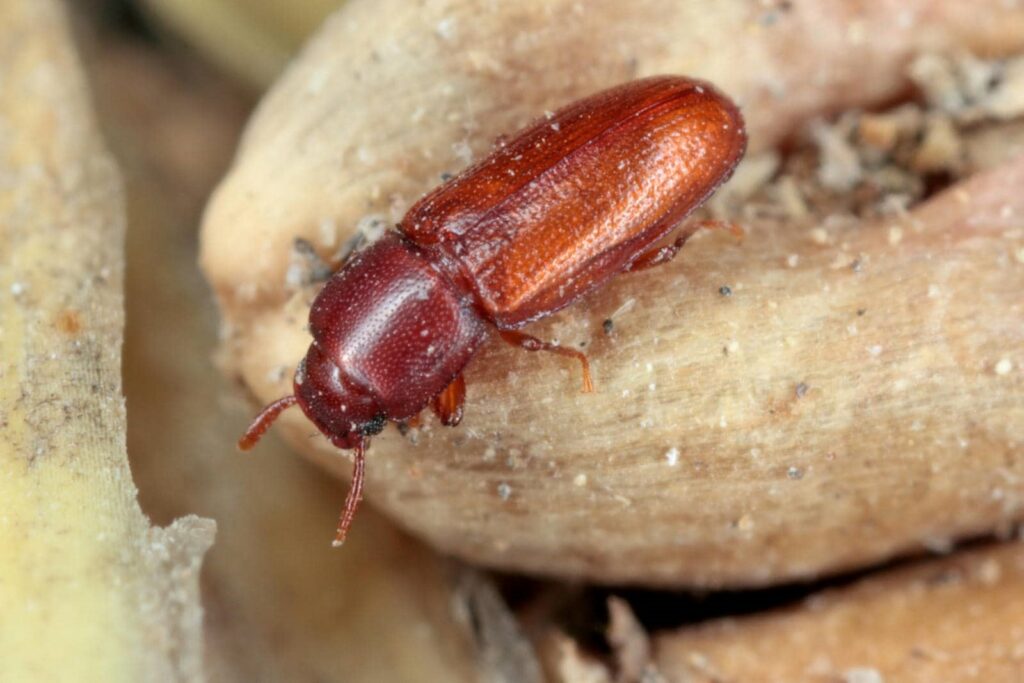
Adults are reddish brown, flattened, and about 3 to 4 mm long, which helps them move through tight food packages. Their beetle behavior includes hiding in crevices, dispersing through storage areas, and surviving on minimal residue.
You can understand them as a persistent storage pest rather than a threat to people. Effective pest management depends on limiting food access, reducing favorable conditions, and interrupting breeding.
When you know their biology, you can respond more confidently and protect shared kitchen spaces.
Signs You Have Red Flour Beetles
You may notice small red-brown beetles near stored food, especially flour, cereal, and grains.
You might also see a fine, powdery residue in containers, which can result from feeding activity and contaminated product.
These signs indicate an active infestation and warrant immediate inspection of nearby food storage areas.
Visible Beetles Near Food
A few tiny, reddish-brown beetles around pantry items often indicate an active red flour beetle infestation. You may notice adults on flour, cereal, spices, or pet food because they feed and move readily through stored products.
This visible presence reflects beetle behavior that favors warm, dry, enclosed spaces where food particles accumulate. When you see them in open containers or along shelf edges, you’re observing an active population, not an isolated visitor.
Prompt inspection matters because these insects can spread quickly through nearby packages and reduce food safety. You’re not dealing with a rare event; you’re seeing a sign that your storage area supports survival.
Identifying them early helps you respond before they establish more hidden colonies elsewhere in your pantry.
Fine Powdery Residue
If you notice a fine, powdery residue near flour, cereal, or other stored foods, red flour beetles may be grinding and contaminating the product as they feed and move.
This fine powder often includes damaged kernels, frass, and shed body parts, so you’re not just seeing mess—you’re seeing evidence of active pantry pests.
You can check seams of bags, corners of bins, and shelf edges for additional residue, because beetles often spread it while searching for food.
If the material feels gritty or keeps reappearing after cleaning, the infestation is likely ongoing.
You’ll want to remove affected items, inspect nearby packages, and store food in sealed containers.
Acting quickly helps you protect your pantry and stay in control together.
Are Red Flour Beetles Dangerous?
Red flour beetles aren’t known to bite, sting, or spread disease, but they can still contaminate stored food and indicate a sanitation problem. You should treat them as a management issue rather than a direct health threat.
Their pest behavior includes rapid reproduction, hiding in dry goods, and persisting when conditions stay warm and favorable. That pattern raises infestation risks in kitchens, pantries, warehouses, and mills.
If you belong to a household or business that values clean storage, prompt removal helps protect food quality and reduce recurring activity. You won’t usually face medical danger, but you may face losses, odors, and customer concern.
Careful inspection, sanitation, and sealed storage support control and help you keep your space secure.
How Red Flour Beetles Contaminate Food
You can identify grain infestation by checking for live beetles, larvae, frass, and damaged kernels in stored food.
As beetles feed and move, they leave waste residue and shed material that can mix with the grain. This contamination reduces food quality by lowering cleanliness, taste, appearance, and overall usability.
Grain Infestation Signs
A contaminated grain supply often shows subtle but telltale signs before a heavy infestation becomes obvious: fine powdery frass, clumped kernels, webbing, hollowed grains, and tiny reddish-brown beetles or larvae near cracks, seams, or storage edges.
You can check grain storage regularly to protect your group’s supply and support pest prevention. Watch for:
- Uneven kernel movement or caking.
- Small adults near warm, hidden zones.
- Grain that feels dusty, warm, or off-color.
You’ll usually spot activity where food stays undisturbed, because beetles prefer protected pockets. Early detection helps you act fast, reduce spread, and keep shared stores usable.
When you inspect, use a flashlight and note every change.
Beetle Waste Residue
Beyond visible beetles and damaged kernels, contamination also comes from the residue they leave behind. You can find frass, shed skins, eggs, and secretions in flour, cereals, and stored grain. These materials spread through containers and cracks, so even a small infestation can affect a larger batch.
In beetle biology, adults and larvae feed, molt, and reproduce in the same food source, which increases residue production over time. You should treat this as a sanitation problem, not just a presence problem. Effective pest management limits breeding sites, removes infested product, and reduces recontamination.
When you inspect regularly and store food in sealed containers, you help protect your shared storage spaces and keep contamination from spreading further.
Food Quality Decline
Red flour beetles degrade food quality by feeding directly on flour, cereals, grains, and processed products, which reduces nutritional value and leaves behind fine particulate contamination.
You may notice clumping, off-odors, and visible frass that signal food contamination in shared storage spaces.
They consume kernels and powdered foods, lowering usable yield.
They deposit shed skins, eggs, and excreta, which can trigger rejection.
Their activity raises moisture and microbial risk, further shortening shelf life.
When you detect these signs, you’re protecting your pantry and your household’s standards.
Effective pest management limits spread, preserves product integrity, and helps you maintain a clean, reliable food supply.
Where Red Flour Beetles Hide in Kitchens
In kitchens, these beetles typically hide in dry, sheltered spots where food particles and warmth persist. You’ll often find them in hiding spots around flour bins, cereal containers, spice shelves, and cracks near baseboards.
They also occupy pantry areas, especially behind stored packages, in folded paper bags, and beneath loose shelf liners. You should inspect seams, corners, and damaged containers, because adults and larvae can move into small gaps that seem secure.
They prefer locations with limited disturbance, so your routine cleaning can expose them. If you belong to a household that values careful food storage, check every dry-goods zone with a flashlight and seal opened products promptly.
Focus on tidy, well-ventilated storage to reduce concealment opportunities.
Why Red Flour Beetles Multiply Fast
You can see red flour beetles multiply fast because they complete a rapid life cycle that produces adults quickly.
Warm grain storage also speeds development and supports continuous breeding.
Each female lays many eggs, which raises population size in a short time.
Rapid Life Cycle
Because red flour beetles develop quickly, a single infestation can expand fast under warm, food-rich conditions. You’re seeing a short life cycle that supports rapid population growth, and their reproductive habits make control harder.
Females lay many eggs directly in flour, cereal, and similar materials, so you may not notice the next generation until it’s already active. Their immature stages develop without dramatic signs, which helps the infestation persist.
- Eggs hatch into larvae in a brief interval.
- Larvae feed, grow, and molt repeatedly.
- Adults mature soon after pupation and reproduce again.
When you identify even a few beetles, you’re likely dealing with a larger hidden group. Quick removal reduces spread, protects shared food supplies, and helps everyone in the space stay ahead of reinfestation.
Warm Grain Storage
Warm grain storage speeds red flour beetle growth by keeping kernels and processed grains in the temperature range that supports feeding, development, and reproduction.
When your grain temperature stays warm, metabolic rates rise, so larvae and adults consume more and mature faster. You can’t rely on cool ambient air alone if storage conditions trap heat in deep bins, sacks, or enclosed corners.
Warm, stable conditions also reduce stress on the insects, letting them remain active and mobile throughout the lot. If you manage your storage conditions carefully, you’ll slow their spread by lowering grain temperature through aeration, insulation, or rotation.
In your facility, even small warm pockets can sustain local populations. Consistent monitoring helps you detect these zones before they support broader infestation.
High Egg Production
Even under moderate conditions, red flour beetles can lay numerous eggs in concealed grain masses, which accelerates population growth. You’re dealing with a species whose reproductive habits support rapid colonization of stored products.
Females place eggs directly in fine flour, cracked kernels, and debris, where moisture and shelter improve egg survival strategies. This hidden placement lets you and your team miss early infestations until adults emerge in large numbers.
Eggs develop in protected food pockets.
Short generation time increases replacement rates.
High fecundity allows repeated infestations.
Because each female contributes many viable offspring, removal becomes harder as density rises. If you monitor grain closely and act early, you’ll protect your storage system and stay aligned with others who value effective pest control.
Why DIY Pantry Beetle Control Fails
DIY pantry beetle control often fails because these insects hide in multiple life stages and spread beyond the most obvious food source. You may clean one shelf, but eggs, larvae, and adults can persist in cracks, seams, and adjacent packages.
DIY methods often miss these concealed pantry pests because they reenter stored food from overlooked containers, shelving joints, and disposal areas. You can reduce visible insects, yet you won’t reliably remove the full infestation without tracing every contaminated item.
Vacuuming, wiping, and discarding infested goods help, but they don’t address scattered survivors. You also risk spreading beetles when you move food during cleanup.
If you want lasting control, you need a complete, systematic approach that accounts for hidden reservoirs, repeated reproduction, and reinfestation from surviving individuals.
Professional Red Flour Beetle Removal
Professional red flour beetle removal starts with a targeted inspection of stored foods, shelving, cracks, and adjacent areas to locate every infestation source.
You benefit from pest control that uses measured methods, because beetles hide in tiny harborages and reproduce quickly. A trained technician will identify life stages, map spread, and apply infestation management steps suited to your site.
- Detect active colonies and egg sites.
- Treat infested zones with appropriate residual or physical controls.
- Verify elimination through follow-up monitoring.
You stay included in the process through clear guidance, so your space returns to a controlled, sanitary condition.
Professional intervention lowers reinfestation risk and helps you protect shared food areas with confidence.
How to Clean Up a Beetle Infestation
After inspection and treatment, cleanup targets the food sources, harborages, and residues that let red flour beetles persist. You should confirm pest identification before you start, so your cleanup matches the species and its habits.
Empty infested containers, discard contaminated flour, cereal, spices, and pet food, and seal waste before removal. Vacuum shelves, cracks, drawer joints, and equipment edges to capture adults, larvae, and dust.
Wipe surfaces with detergent and warm water to remove eggs, frass, and food film. Use cleanup strategies that focus on dry storage areas, because even small spills can support survivors. Clean nearby packaging, assess hidden seams, and inspect reusable bins.
When you work systematically, you protect your shared space and reduce the chance of ongoing beetle activity.
How to Prevent Red Flour Beetles
To prevent red flour beetles, you need to remove the conditions that support feeding, breeding, and shelter. You can lower risk with consistent preventive measures and disciplined pantry organization.
Store flour, cereal, and grains in airtight containers, and inspect seals regularly.
Clean shelves, cracks, and corners with a vacuum and soap solution, then dry surfaces completely.
Rotate stock using first in, first out, and discard damaged or expired products promptly.
You should also reduce humidity, since beetles thrive in warm, moist areas. Check bulk purchases before bringing them inside, and isolate suspicious packages.
When you keep your pantry structured and sealed, you create an environment where beetles can’t establish stable populations. That control helps your household stay protected, organized, and confident.
Frequently Asked Questions
What Attracts Red Flour Beetles to Homes?
You attract red flour beetles with accessible food sources like flour, cereal, and spices, plus warm, humid environmental factors. You’re most vulnerable when packaging is open, crumbs accumulate, and pantry storage stays undisturbed.
Can Red Flour Beetles Infest Sealed Packages?
Yes, they can. Like a single grain in a jar ruining a batch, one beetle can slip through tiny gaps. You’ll need infestation prevention through airtight storage and pest control to protect your pantry.
How Long Do Red Flour Beetles Live?
You’ll usually see a red flour beetle lifespan of about one year, though temperature and food change it. Their beetle reproduction cycle can continue quickly, so you’ll want to monitor stored grains carefully.
Do Red Flour Beetles Bite People?
No, red flour beetles don’t bite people. You’ll usually see them infesting stored grains. For effective pest control, you should remove contaminated food and clean storage areas, since they’re a nuisance, not a biting threat.
Can Red Flour Beetles Damage Electronics?
Yes, red flour beetles can contaminate electronics if you store food nearby. Their red flour beetle habits drive them toward crumbs and warmth. You should use pest control methods and seal devices to protect your space.
Recap
Red flour beetles can turn your pantry from a clean storage space into a contaminated reservoir of eggs, larvae, and waste. You may see scattered insects on one shelf; hidden infestations can persist in cracks, seams, and packaged foods. DIY cleanup often removes the visible adults but leaves the source behind. Professional removal, paired with thorough sanitation and prevention, helps you protect food quality, reduce losses, and keep your kitchen sanitary.
Recent Posts
Mouse Droppings vs Rat Droppings: Identify Your Intruder
You may not know that droppings can tell you more than just whether rodents are
What Attracts Mice to a Clean House? 7 Surprising Culprits
Some homes report some mouse activity each year, and even a spotless house can still
How Do Exterminators Get Rid of Mice? A Look Inside the Process
When you call an exterminator for mice, the process starts with a careful inspection to